Join Essenvia at RAPS Convergence 2026 — Booth #918
· Charlotte, 15–17 September
Read more →

What delays device registrations in Brazil, Mexico and India
Filing in a new market
By Soumya Mahapatra

You have the CE certificate, the 510(k) and a launch date. You budget against the review times ANVISA, COFEPRIS and CDSCO publish, add a margin, and file. A year later the file is open and none of the correspondence has been about clinical evidence.
Almost all of the gap between published review time and elapsed time comes from artifacts you cannot produce yourself: documents issued by other parties, authenticated by a government, translated by a licensed individual, accepted only in one form. Each has its own lead time, its own failure mode and — the part that catches people — its own expiry. Which markets to file in and in what order is covered in [the pillar piece on pre-filing decisions] and [the piece on filing order across markets]; this piece assumes that decision is made.
Two kinds of delay, and neither is related to review
Pre-clock time
Everything between "we decided to file" and "the file is accepted": assembling, legalising and translating documents other parties issue, plus any national requirement on its own timeline. Most of the loss sits here, invisible in published timelines because the clock has not started.
Allowances for the document chain alone, where other parties must issue the documents:
Brazil | Mexico | India | |
|---|---|---|---|
Typical | 3–6 weeks | 4–8 weeks | 2–5 weeks |
Conservative | 6–10+ weeks | 8–12+ weeks | 5–8+ weeks |
Plan against | 6 weeks | 8 weeks | 4 weeks |
Risk case | 10 weeks | 12 weeks | 8 weeks |
Within each range, roughly one to four weeks goes to third parties issuing documents, one to two to apostille, and days to two weeks to translation and assembly; the steps overlap, so do not add the maxima. Mexico carries the largest allowance because more documents require authentication, India the smallest if your source documents are in English. These are planning allowances, not observed outcomes — and they overlap, for a reason worth stating.
The biggest variable is not the authority. It is the issuing country and the issuer. A Free Sale Certificate that takes a home-country authority four weeks to issue moves the critical path in all three markets by the same four weeks. An apostille obtainable electronically in one jurisdiction and only by consular chain in another moves a schedule by weeks on its own — that route is most of the distance between the typical and conservative columns.
Brazil's conformity certification is the sharpest case, because it is a gate rather than a lead time. Where certification is compulsory, RDC 751/2022 requires the SBAC certificate as an application document — Art. 14 for Class III and IV registration, Art. 13 for Class I and II notification — and Art. 10 §4 allows an application missing it to be denied outright rather than cured through an exigência. Brazilian GMP runs the opposite way: the protocol showing the certificate was requested is accepted while review proceeds. So testing and certification finish before Day 0.
Clock-stopped time
All three exclude applicant response time from the review period, so the published figure is agency time rather than elapsed time — and they exclude it by three different mechanisms.
Brazil interrupts: the registration period stops until the applicant satisfies the exigência (Lei nº 6.360/1976, as amended). Mexico suspends and resumes: the clock stops on notification of the prevención and restarts the business day after the response. India restarts the step: CDSCO's timeline note runs the timeline from the date the response is received, and the Medical Devices Rules, 2017 reckon the scrutiny period for rectifiable deficiencies from the date they are removed.
That matters when for estimation: an interruption or suspension gives back time already served, a restart does not. What does not happen anywhere is a return to the back of a queue. The risk sits at the other end of the window.
Brazil — exigência técnica | México — prevención | India — CDSCO query | |
|---|---|---|---|
Response window | 120 days, non-extendable, from confirmation or reading of the exigência. The shorter exceptions ANVISA publishes concern import petitions and tobacco, not device registration. | No fixed period. COFEPRIS sets it in the prevención and it cannot be less than five business days from effective notification. LFPA Art. 17-A. Art. 31 allows extension of up to half the original period. | No general rule under MDR 2017. The operative rule is CDSCO's backlog mechanism of 16 January 2026: three reminders at 30-day intervals, then disposal 30 days later — an outer window of roughly 90 days from the first reminder. |
If it expires | Petition rejected — indeferimento. RDC 204/2005, Art. 11. | Proceeding discarded — desechamiento. LFPA Art. 17-A. Closure requiring a new filing. | Rejection with fee forfeited. The notice expressly covers medical devices and IVDs. |
Set that beside the numbers above. A deficiency requesting a new foreign document requires the whole chain again — two to eight weeks before the deficiency itself. Brazil's 120 days does cover that, not comfortably; however, India's roughly 90 days is tighter. A prevención at the floor of five business days cannot be met by any document that has to be reissued and re-authenticated abroad, and because COFEPRIS sets the period case by case you do not know which window you have until it arrives.
The response window is not a drafting deadline. It is a procurement deadline, and it can be shorter than the procurement takes.
The document chain only runs one way
Every foreign-issued document runs the same sequence, and the order is fixed: signature → notarisation → apostille → translation → submission.
ANVISA treats the authentication as part of the document. Where the apostille/legalization material is not in Portuguese, English or Spanish, that authentication material must also be covered by the sworn translation.
Operationally, Brazil therefore follows:
final document → apostille/legalization → inspect authentication language → sworn translation of all portions outside PT/EN/ES.
That means you should not commission the final translation before authentication if the apostille/legalization may introduce content requiring translation. Whereas, Mexico and India impose no equivalent express requirement, so translating before legalising costs you twice in Brazil and is merely out of order elsewhere.
All three file electronically, so what matters is the form of authentication, and it varies within a dossier rather than across the three. Brazil and Mexico accept apostille, or consular legalisation where the Hague route is unavailable, for documents issued by foreign authorities. India splits the two: the Power of Attorney needs an Indian First Class Magistrate, the Indian Embassy in the country of origin, or apostille, while free-sale and quality certificates go in as notarised copies. Check Mexico route by route — some require an original or notarised copy.
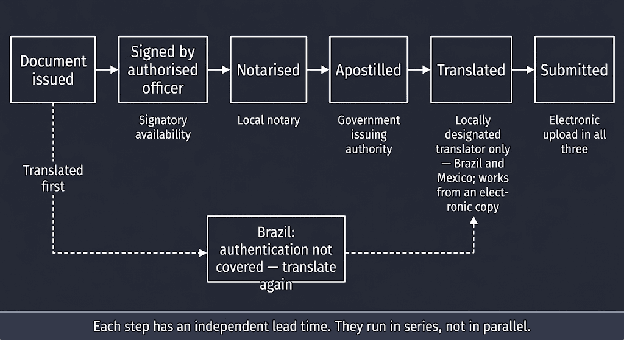
Figure: Process flow showing the five sequential steps of document legalisation, with a dashed branch showing the rework caused by translating before the apostille is issued.
Who is allowed to do each step
In Brazil and Mexico the translator must be locally designated: Brazil's tradutor público juramentado, commissioned through a state commercial board, and Mexico's perito traductor, authorised by the judiciary. A translator sworn in your own country substitutes for neither, and a bad translation cannot be escalated with a supplier — you re-run the step.
CDSCO works in English throughout, and appears to have no equivalent register. India's advantage is not that translation disappears but that it is unlicensed: a document in another language goes in as an English translation alongside the original, so non-English certificates cost India part of its lead.
Who holds the registration, and how hard it is to move
The registration or import licence sits with a local entity. What differs — and what most planning gets wrong — is how hard it is to change later.
Brazil (ANVISA) | Mexico (COFEPRIS) | India (CDSCO) | |
|---|---|---|---|
Who holds it | The Brazilian registration or notification holder — the entity responsible for the device in Brazil | The titular del registro sanitario. Holder, legal representative, importer and commercialiser are distinct roles and need not be one person | The Indian Authorized Agent, named on the MD-15 import licence |
What it must have | Brazilian legal entity with the appropriate AFE; only companies constituted in Brazil can apply for one | A Mexican establishment able to act as holder, with the applicable establishment and responsible-sanitary notifications | A manufacturing licence, wholesale licence, or Form MD-42 registration certificate; appointed by authenticated Power of Attorney, applying on Form MD-14 under Rule 34 |
Hold it yourself? | No | Not without Mexican establishment or representation | No, for an ordinary commercial MD-15 |
Moving it later | Hardest of the three. No route removes the Brazilian holder | Cesión de derechos. Since 8 July 2024 COFEPRIS has run an immediate-resolution window advertising 24 business hours for qualifying submissions | Rule 39 requires a fresh application after a relevant change in constitution, and treats the POA-granting manufacturer as within the concept of licensee for that purpose |
That last row inverts the usual advice. "Never let your distributor hold the registration" is strongest in Brazil, where the authorisation belongs to the Brazilian holder and nothing removes it, and weakest in Mexico, where assignment moves in a day. Brazil's escape is that the holder need not be your subsidiary — an independent regulatory representative with the required authorisations qualifies. But 24 business hours is the administrative step, not the negotiation preceding it.
Labels, and the number you do not have at filing
Labels and instructions for use are dossier content, so the artwork submitted is the artwork approved. Portuguese and Spanish are mandatory; India sets no Hindi requirement and English is used. But two of the three let you add local information after import, which changes what has to be right at filing.
Brazil | Mexico | India | |
|---|---|---|---|
Legal basis | RDC 751/2022, Ch. VI, Arts. 46–53 | NOM-137-SSA1-2008, with NOM-137-SSA1-2025 published 19 May 2026 and effective 360 days later | Medical Devices Rules, 2017, Ch. VI, Rule 44 |
Adding information in country | Possible, but against the approved configuration and under GMP controls | Expressly permitted: a counter-label may be applied after customs clearance, before commercialisation | Expressly permitted: importer and licence details may be added by sticker |
So the licence number you lack at submission is a sticker problem in Mexico and India. Brazil is the constrained case: relabelling runs against an approved configuration under quality-system control, not as a warehouse task. And Mexican artwork should now be built to the 2025 standard.
What to do on Monday
The constraint that breaks otherwise good plans is arithmetic, not regulation. A four-week document with a six-month window cannot simply be started first: if your slowest artifact takes five months and you started the short-window ones alongside it, they expire while you wait.
So build an artifact register before a submission plan. One row per document, six columns: the artifact, who issues it, issuance lead time, its legalisation steps, its validity window, and what it depends on. Rank by total chain time — issuance plus legalisation plus translation — and run it backwards from your target submission date rather than forwards from today. The longest chain sets the filing date; everything else schedules against it.

The register also forces the holder's decision, because you cannot fill half the rows until you know which local entity is named on them. Which is the right order.
You have the CE certificate, the 510(k) and a launch date. You budget against the review times ANVISA, COFEPRIS and CDSCO publish, add a margin, and file. A year later the file is open and none of the correspondence has been about clinical evidence.
Almost all of the gap between published review time and elapsed time comes from artifacts you cannot produce yourself: documents issued by other parties, authenticated by a government, translated by a licensed individual, accepted only in one form. Each has its own lead time, its own failure mode and — the part that catches people — its own expiry. Which markets to file in and in what order is covered in [the pillar piece on pre-filing decisions] and [the piece on filing order across markets]; this piece assumes that decision is made.
Two kinds of delay, and neither is related to review
Pre-clock time
Everything between "we decided to file" and "the file is accepted": assembling, legalising and translating documents other parties issue, plus any national requirement on its own timeline. Most of the loss sits here, invisible in published timelines because the clock has not started.
Allowances for the document chain alone, where other parties must issue the documents:
Brazil | Mexico | India | |
|---|---|---|---|
Typical | 3–6 weeks | 4–8 weeks | 2–5 weeks |
Conservative | 6–10+ weeks | 8–12+ weeks | 5–8+ weeks |
Plan against | 6 weeks | 8 weeks | 4 weeks |
Risk case | 10 weeks | 12 weeks | 8 weeks |
Within each range, roughly one to four weeks goes to third parties issuing documents, one to two to apostille, and days to two weeks to translation and assembly; the steps overlap, so do not add the maxima. Mexico carries the largest allowance because more documents require authentication, India the smallest if your source documents are in English. These are planning allowances, not observed outcomes — and they overlap, for a reason worth stating.
The biggest variable is not the authority. It is the issuing country and the issuer. A Free Sale Certificate that takes a home-country authority four weeks to issue moves the critical path in all three markets by the same four weeks. An apostille obtainable electronically in one jurisdiction and only by consular chain in another moves a schedule by weeks on its own — that route is most of the distance between the typical and conservative columns.
Brazil's conformity certification is the sharpest case, because it is a gate rather than a lead time. Where certification is compulsory, RDC 751/2022 requires the SBAC certificate as an application document — Art. 14 for Class III and IV registration, Art. 13 for Class I and II notification — and Art. 10 §4 allows an application missing it to be denied outright rather than cured through an exigência. Brazilian GMP runs the opposite way: the protocol showing the certificate was requested is accepted while review proceeds. So testing and certification finish before Day 0.
Clock-stopped time
All three exclude applicant response time from the review period, so the published figure is agency time rather than elapsed time — and they exclude it by three different mechanisms.
Brazil interrupts: the registration period stops until the applicant satisfies the exigência (Lei nº 6.360/1976, as amended). Mexico suspends and resumes: the clock stops on notification of the prevención and restarts the business day after the response. India restarts the step: CDSCO's timeline note runs the timeline from the date the response is received, and the Medical Devices Rules, 2017 reckon the scrutiny period for rectifiable deficiencies from the date they are removed.
That matters when for estimation: an interruption or suspension gives back time already served, a restart does not. What does not happen anywhere is a return to the back of a queue. The risk sits at the other end of the window.
Brazil — exigência técnica | México — prevención | India — CDSCO query | |
|---|---|---|---|
Response window | 120 days, non-extendable, from confirmation or reading of the exigência. The shorter exceptions ANVISA publishes concern import petitions and tobacco, not device registration. | No fixed period. COFEPRIS sets it in the prevención and it cannot be less than five business days from effective notification. LFPA Art. 17-A. Art. 31 allows extension of up to half the original period. | No general rule under MDR 2017. The operative rule is CDSCO's backlog mechanism of 16 January 2026: three reminders at 30-day intervals, then disposal 30 days later — an outer window of roughly 90 days from the first reminder. |
If it expires | Petition rejected — indeferimento. RDC 204/2005, Art. 11. | Proceeding discarded — desechamiento. LFPA Art. 17-A. Closure requiring a new filing. | Rejection with fee forfeited. The notice expressly covers medical devices and IVDs. |
Set that beside the numbers above. A deficiency requesting a new foreign document requires the whole chain again — two to eight weeks before the deficiency itself. Brazil's 120 days does cover that, not comfortably; however, India's roughly 90 days is tighter. A prevención at the floor of five business days cannot be met by any document that has to be reissued and re-authenticated abroad, and because COFEPRIS sets the period case by case you do not know which window you have until it arrives.
The response window is not a drafting deadline. It is a procurement deadline, and it can be shorter than the procurement takes.
The document chain only runs one way
Every foreign-issued document runs the same sequence, and the order is fixed: signature → notarisation → apostille → translation → submission.
ANVISA treats the authentication as part of the document. Where the apostille/legalization material is not in Portuguese, English or Spanish, that authentication material must also be covered by the sworn translation.
Operationally, Brazil therefore follows:
final document → apostille/legalization → inspect authentication language → sworn translation of all portions outside PT/EN/ES.
That means you should not commission the final translation before authentication if the apostille/legalization may introduce content requiring translation. Whereas, Mexico and India impose no equivalent express requirement, so translating before legalising costs you twice in Brazil and is merely out of order elsewhere.
All three file electronically, so what matters is the form of authentication, and it varies within a dossier rather than across the three. Brazil and Mexico accept apostille, or consular legalisation where the Hague route is unavailable, for documents issued by foreign authorities. India splits the two: the Power of Attorney needs an Indian First Class Magistrate, the Indian Embassy in the country of origin, or apostille, while free-sale and quality certificates go in as notarised copies. Check Mexico route by route — some require an original or notarised copy.
Figure: Process flow showing the five sequential steps of document legalisation, with a dashed branch showing the rework caused by translating before the apostille is issued.
Who is allowed to do each step
In Brazil and Mexico the translator must be locally designated: Brazil's tradutor público juramentado, commissioned through a state commercial board, and Mexico's perito traductor, authorised by the judiciary. A translator sworn in your own country substitutes for neither, and a bad translation cannot be escalated with a supplier — you re-run the step.
CDSCO works in English throughout, and appears to have no equivalent register. India's advantage is not that translation disappears but that it is unlicensed: a document in another language goes in as an English translation alongside the original, so non-English certificates cost India part of its lead.
Who holds the registration, and how hard it is to move
The registration or import licence sits with a local entity. What differs — and what most planning gets wrong — is how hard it is to change later.
Brazil (ANVISA) | Mexico (COFEPRIS) | India (CDSCO) | |
|---|---|---|---|
Who holds it | The Brazilian registration or notification holder — the entity responsible for the device in Brazil | The titular del registro sanitario. Holder, legal representative, importer and commercialiser are distinct roles and need not be one person | The Indian Authorized Agent, named on the MD-15 import licence |
What it must have | Brazilian legal entity with the appropriate AFE; only companies constituted in Brazil can apply for one | A Mexican establishment able to act as holder, with the applicable establishment and responsible-sanitary notifications | A manufacturing licence, wholesale licence, or Form MD-42 registration certificate; appointed by authenticated Power of Attorney, applying on Form MD-14 under Rule 34 |
Hold it yourself? | No | Not without Mexican establishment or representation | No, for an ordinary commercial MD-15 |
Moving it later | Hardest of the three. No route removes the Brazilian holder | Cesión de derechos. Since 8 July 2024 COFEPRIS has run an immediate-resolution window advertising 24 business hours for qualifying submissions | Rule 39 requires a fresh application after a relevant change in constitution, and treats the POA-granting manufacturer as within the concept of licensee for that purpose |
That last row inverts the usual advice. "Never let your distributor hold the registration" is strongest in Brazil, where the authorisation belongs to the Brazilian holder and nothing removes it, and weakest in Mexico, where assignment moves in a day. Brazil's escape is that the holder need not be your subsidiary — an independent regulatory representative with the required authorisations qualifies. But 24 business hours is the administrative step, not the negotiation preceding it.
Labels, and the number you do not have at filing
Labels and instructions for use are dossier content, so the artwork submitted is the artwork approved. Portuguese and Spanish are mandatory; India sets no Hindi requirement and English is used. But two of the three let you add local information after import, which changes what has to be right at filing.
Brazil | Mexico | India | |
|---|---|---|---|
Legal basis | RDC 751/2022, Ch. VI, Arts. 46–53 | NOM-137-SSA1-2008, with NOM-137-SSA1-2025 published 19 May 2026 and effective 360 days later | Medical Devices Rules, 2017, Ch. VI, Rule 44 |
Adding information in country | Possible, but against the approved configuration and under GMP controls | Expressly permitted: a counter-label may be applied after customs clearance, before commercialisation | Expressly permitted: importer and licence details may be added by sticker |
So the licence number you lack at submission is a sticker problem in Mexico and India. Brazil is the constrained case: relabelling runs against an approved configuration under quality-system control, not as a warehouse task. And Mexican artwork should now be built to the 2025 standard.
What to do on Monday
The constraint that breaks otherwise good plans is arithmetic, not regulation. A four-week document with a six-month window cannot simply be started first: if your slowest artifact takes five months and you started the short-window ones alongside it, they expire while you wait.
So build an artifact register before a submission plan. One row per document, six columns: the artifact, who issues it, issuance lead time, its legalisation steps, its validity window, and what it depends on. Rank by total chain time — issuance plus legalisation plus translation — and run it backwards from your target submission date rather than forwards from today. The longest chain sets the filing date; everything else schedules against it.
The register also forces the holder's decision, because you cannot fill half the rows until you know which local entity is named on them. Which is the right order.



See what your portfolio looks like when everything is sellable — and audit-ready.
A 30-minute demo, on your products and your markets. No sandbox, no trial to configure — a working conversation with people who know regulatory.
See what your portfolio looks like when everything is sellable — and audit-ready.
A 30-minute demo, on your products and your markets. No sandbox, no trial to configure — a working conversation with people who know regulatory.
See what your portfolio looks like when everything is sellable — and audit-ready.
A 30-minute demo, on your products and your markets. No sandbox, no trial to configure — a working conversation with people who know regulatory.